Monday, October 15, 2012

Medicating Pets

I don’t know about you, but sometimes we have a very difficult time giving our pets their medication.  Merlin, my cat, used to be horrible to give medication to.  He was declawed on his front claws, but he still had his back claws and teeth.  I have the scars to prove it.  Merlin absolutely hated taking medication; forget trying to get a pill down his throat. 

Then there was Socrates, my peach-faced lovebird.  Socrates got very sick one year and we found out he had liver disease.  I had to give him shots every day for a week.  Have you ever had to give a bird a shot?  It is not an easy thing to do. 


We also have some difficulty with some of our dogs and giving them medication.  Tucker, one of our long term sanctuary dogs will not take his medicine.  It is a fight every time.  Tucker used to be a guard dog for a drug operation.  He was pretty vicious when he first came to the sanctuary.  He is a perfect gentleman now…that is until it is time to give him medicine.


Well, with all the dogs that have been in and out of the rescue, we have almost become pet medication experts.  There are still some that will stump us every now and then, but it’s not often.  The technique we use depends on the dog.  Our favorite method of choice is with a pill pocket.  The puppies, and our, favorite is Greenies brand pill pockets.


They are soft and we can form them around the pill.  I like to put the pill in it, pinch the end, and then roll it in a ball.  We act like we are giving the pups a treat.  There are still those pups, and the occasional cat, that will eat the treat around the pill and spit the pill back out.

With anywhere from 10-15 dogs in the rescue at any given time, and most of those seniors, we give a lot of pills every day.  The pill pockets are not always economical for us, so we have looked for alternatives.  What we have found that works just as good as the pill pickets are a soft chewy treat called Canine Carry Outs (Beef Flavored). 


If they are fresh, they are soft enough to use as is.  We just make a little hole in them with a tooth pick, put the pill in it, form it around the pill and then give it to the pups.  If they are a bit older though, they will break apart when you try this.  We put them in the microwave for 15-20 seconds.  Then let them cool off and they will work just fine.

Now if this doesn’t work for your pet, we have found it difficult for even the most finicky dog to turn down canned food.  Our favorite is Purina One Lamb & Rice, ground, not chunks.  In cases where the pill pocket doesn’t work, we will put the pill in a ball of canned food.  They will almost always swallow this down whole. 


Almost always.  There are those which this doesn’t even work for.  In cases like this we ask the vet if the medicine can be ground up.  If it can, we grind it up and put it in a syringe…not the kind with a needle, the kind used to give liquid medicine. 


Pull the plunger all the way out, but your finger over the tip and pour the ground up pill into the syringe.  Then put the plunger back in.  Squeeze the air out, but don’t compress the ground up pill.  Turn on your tap for warm water.  Suck it into the syringe and shake it up until the medicine dissolves.  You may need to let it sit for a few minutes.  Shake it up again before giving it to your dog or cat.  To give it to your pet lift up the lip on the side of the mouth and put the tip of the syringe between two back teeth and then squeeze it in really fast.  Hold your pets head up so that they have to swallow.


There are also the old standbys of cream cheese and peanut butter as well.  What dog can turn down cream cheese??  We had one pup that none of these things would work on.  In that case, we just opened her mouth and with a finger put it down her throat and held her mouth closed stroking her throat till she swallowed it.

We hope some of these tips work for you.  We are always trying out new things, so if we find anything else that works, we will let you know.

Be Well & Be Happy,
Pet~Pourri

Thursday, October 11, 2012

Pets & Halloween


Did you ever wonder why you can’t adopt black cats from local shelters around Halloween?? 

Many people will adopt them to be a part of their Halloween festivities and then return them as soon as the festivities are over.  While there are no statistics on black cats being tortured around Halloween, we have all heard the stories.  Of course we all know some of these stories are exaggerated, it still puts the idea into people’s heads.  And unfortunately, some people will act on those ideas.  Some are ritualistic and some are just because.  Not matter the reason, it is still cruel!!


Superstition has plagued the black cat over the centuries.  Even as far back as Greek Mythology black cats were believed to be priestess’ of the goddess Hectate, the Dark Mother.  Of course we all know about them being witches familiars.  During the witch-burning era they were placed in baskets and burned alongside the witches.  Around the world today black cats still represent bad luck.  How many of you have heard the saying, don’t let a black cat cross your path?


If you own a black cat, keep it inside this month to keep it safe.  Better yet, keep your cat inside no matter what color it is.  The week leading up to Halloween you should keep all your pets inside and safe.  Many different communities allow trick or treating on different nights during that week and the extra traffic will be disorienting and could be distressing to your pet.  There will be a lot of noise and strangers in your neighborhood.  This can be very upsetting to your pet as well and it is best to take precautions to keep your pet safe.


Here is a link to the ASPCA with suggestions on pet safety during Halloween.

You definitely want to keep the candy away from your pets.  Chocolate especially can be toxic to your pet.  There is a chemical called Theobromine in chocolate that is poisonous to your pets.  Here is a link with more information on Theobromine poisoning.  This substance can also be found in tea, cola, acai berries, and some other foods as well.


Candles can also be dangerous to you and your pets during Halloween.  Try to keep your jack-o-lanterns out your pets reach.  I know my cat Merlin used to be fascinated by candle flames.  He wanted to try and catch the moving flame.  I was fortunate enough to be right there and saw him trying to swat the flame.  I immediately blew it out and only burned candles where he would not be able to reach them or where I could supervise him around them. 


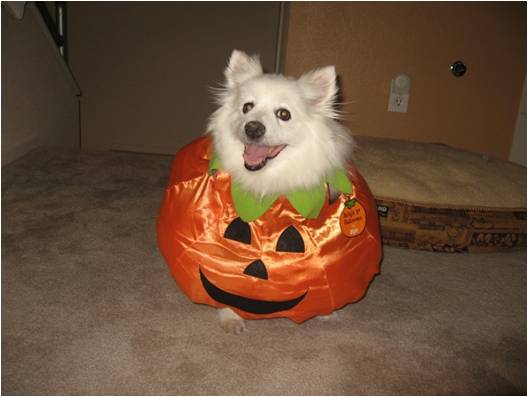
 If you want to dress your pet up for Halloween, make sure the costume fits him properly and are not constricting.  You also want to make sure it does not block your pets vision.  Think of how your pet reacts when you put an Elizabethan collar on them, you know the lamp shade collars?  J  If your pets costume is held on by those rubber bands, keep an eye out to make sure they don’t cause injury.  They may rub a raw spot that may turn into a sore or they may be too tight causing constriction which can cut off the blood supply and be very dangerous.


Here is wishing you and your pet a Safe and Happy Halloween.


Be Well & Be Happy,
Pet~Pourri
Saturday, October 6, 2012

Mountain Lions!!!


There are Mountain Lions in Des Moines Iowa!!  Yes…really.  On October 4th, a mountain lion was shot and killed by Des Moines police in the back yard of a home on Columbia Street, just two blocks away from an elementary school about the time the kids would have been outside for recess.


Now you may be asking what does this have to do with a pet blog.  It got me to thinking what would a mountain lion be doing in such an urban populated area.  Are our pets safe?  So I did a little research. 

According to the Iowa DNR website (www.iowadnr.gov), mountain lion were eradicated by early pioneers.  In the late 1990’s they started receiving reports from people spotting mountain lions.  The first confirmed sighting was in midsummer 2001.  Bobcats and large yellow labs and shepherds are often mistaken for Mountain Lions.


The Iowa DNR is trying to place Mountain Lions and Black Bears on the Iowa Code as designated wildlife species.  They are not currently because they were thought to be eradicated from Iowa.  Until the sightings in the late 1990’s, the last reported sighting in Iowa was in 1867 when one was shot in Appanoose County. 


Mountain Lions can live 12-20 years, but not many live past 12.  Female lions have an average ‘home’ range of 90 miles.  Male lions however have a range of 300 miles.  Their food of choice are small mammals and deer.  Given the opportunity, they will go after small mammals and birds.  Therefore, if you hear of a sighting in your area, make sure your pets are protected by bringing them in the house or putting them in some kind of shelter.

If you come face to face with a mountain lion the DNR suggest you:


1.      Savor the moment.  It is a rare opportunity and not many people get to see one in person. But do not approach them.

2.      DON’T RUN.  Stay Calm.  Running will make them think you are prey and chase you.

3.      Stand tall and make yourself look as big as possible.

4.      Scream loudly and throw objects.

5.      Gather children in close and slowly back away, keeping eye contact with the lion.


Urban sprawl has contributed to an increase in sightings.  As more humans take over their territory sightings have increased.  It is still very unusual to see them in such a populated area; however, they are becoming accustomed to our presence in their territory.  Another reason for increased sightings in urban areas is the drought.  They are searching for food and water.

Be assured however that it is very rare for a mountain lion to attack adult humans.  It is your pets and children you should be worried about, especially between dusk and dawn as this is when lions hunt.  Keep your pets and other animals indoors or in a secured shed, with a sturdy roof.  Walk your pet on a leash.  Roaming pets are an easy target.  Feed them indoors as well. 

Mountain lions are not the only wildlife that may endanger your pet.  Coyotes, eagles, and bears have also been known to carry off an unprotect pet.  Keep your pet safe and secure and be aware of any sightings in your area.


Be Well & Be Happy,

Pet~Pourri

Thursday, October 4, 2012

Fleas, Fleas, and More Fleas

Today we would like to discuss a very annoying pest.  Here at the rescue we have been very fortunate not to have a problem with fleas...until this year that is.  Late summer we noticed several of the pups itching like crazy.  We thought maybe it was allergies and gave them all oatmeal baths. 


Then...GASP...while Sophia was sitting on my lap one day this little bug jumped on my arm.  It was a FLEA!!! 


I started looking her over from head to toe and saw another one.  I immediately gave her a bath with flea shampoo and again bathed the other dogs.  Then we treated them all with Frontline.  We washed all the bedding and cleaned the whole house and bombed and sprayed the whole house. 


Next day...they were scratching like crazy again.  Then I found another flea, this time on Tinkerbell.  didn't want their skin to dry out so I waited a week to bathe them and treat them again, but still more fleas.  I couldn't believe they would not go away.  We've never had problems like this before. 

So then I asked some friends and heard that many of them are having trouble this year.  Many of them also said that Frontline isn't working for them.  None of them have ever had issues like this before.  Dogs, Cats, and horses all having fleas.  Yes I know horses don't normally get fleas, but they can be infested with fleas common with dogs and cats. 


Dr. Becker from Healthypets.com states that many veterinarians were predicting 2012 to be the worst year for fleas in a decade.  She uses natural remedies and discourages people from using chemicals to treat for fleas.  She states that she sees many pets suffering from these toxic drugs.

Dr. Becker recommends you comb your pet daily with a flea comb.  Then give your pet a soothing bath, this will kill the fleas by drowning them and help with any skin issues they may be having.  She recommends you do not use a grain shampoo such as an oatmeal shampoo.

So what can you use as a repellent??  If you don't want to use chemicals, Dr. Becker recommends cedar oil (formulated for pets), food grade diatomaceous earth (DE), and fresh garlic.  Powdered garlic or garlic in tablet form has lost the medicinal component, Allicin, found in fresh garlic. Garlic pills can be dangerous to pets. 

I really found this article to be very informative as I prefer natural treatments.  Here is a link to the entire article.  It is called Flea and Tick Season 2012: It's Early and It's Ugly.

One thing to watch for is skin irritation.  Many pets are actually allergic to fleas.  This is a severe case.


Here at the rescue, we are doing the soothing baths.  A ton of fleas came off of all the puppies, but again, they are still itching.  I have to watch to see how much of it is from fleas and how much of it is skin irritation or flea allergy.  Here is Princess having her bath.  What a little prima donna.  :)


I also did a little research on traditional preventatives for fleas.  The top three are Frontline, Advantage, and Capstar.  I'm not sure if we are going to try any of these.  We are going to experiment with a few ideas.  I'll keep you updated on what we try and what works and doesn't work.  Hopefully they will go away never to be seen again.  :)

Be Well & Be Happy
Pet~Pourri

Wednesday, October 3, 2012

Healthiest State ~ Healthiest Pet

Welcome to our first post on Pet~Pourri.  Our goal is to be an informational blog site for all kinds of pet owners.  What makes us qualified to do this?  We have been rescuing animals for over 25 years.  Primarily American Eskimo Dogs, but also other types of animals.  We hope this is the beginning of a beautiful friendship.


Today, in Iowa, was the Healthiest State Walk, an event sponsored by Iowa's Healthiest State Initiative.


This is an initiative for all Iowans to improve their health.  It's as simple as taking a walk.  Today participants were asked to walk at least 2 kilometers.  For my company, this was two times around the pond on our grounds. 

So you may ask me what this has to do with pets.  Well...I decided to use this opportunity to take our rescue dogs for a walk.  This helps me get healthy, but it also helps our pets get healthy.  People who love their pets sometimes tend to shower them with love by giving them lots of treats.  Well...pets also need to watch what they eat.  This goes for all types of pets, not just dogs.

I decided to do some research on helping you and your pet get healthy.  I found out that, as of February 2012, 54% of the nation's pets are overweight.  What is sad is that many people don't realize their pets are overweight.  Dr. Ernie Ward of the Association for Pet Obesity Prevention states that 22% of dog owners and 15% of cat owners believe their pets are normal weight, when they are actually overweight. 

How many of you saw the story last month about Obie the overweight dachshund??  His owners showed him love by feeding him.  A Lot! 


When Obie was rescued he weighed 77 pounds.  Top weight for a large standard dachshund is around 30 pounds.  Obie is more than 40 pounds overweight.  He is only 5 years old.  His rescuer is on track to help him loose the extra weight.  Today Obie is down to 67 pounds.  Stay tuned for occasional updates on his progress.  You can also follow his progress by visiting his Facebook page.

This brings me to the main topic for this post.  What can we do to keep our pets Healthy??  Same as for humans.  Exercise.


Here is an article that was posted on the Huffington Post today sharing 11 Ways To Exercise With Your Pet.  Anything from hide and seek, to walking, to swimming along with some other excellent ideas.  One of my favorite things to do with my cat was letting him try and catch the light from one of those laser lights.  He loved it and it was fun for me too.  Believe it or not, laughing does burn calories.


Be Well & Be Happy!!
Pet~Pourri